
Enter the Progressives
toward a better US national security debate


Here at Blue Blaze we’ve promised to take you off the main trail when it comes to matters of US foreign policy and international politics. This post kicks off a special series that aims to do that by exploring the progressive vision for US foreign policy.
Today, scholars and commentators are waging a battle over U.S. foreign and national security policy. Since the Cold War’s end, the United States—enjoying economic and military dominance—has pursued an ambitious grand strategy of “global leadership.” But the Trump administration, brought to power twice by a populist backlash against turbocharged globalization and costly military misadventures, casts that strategy as a failure. In its telling, global leadership has hollowed out American prosperity and undermined national security.
In this debate, it’s the realists and liberal internationalists who are—as ever—sucking up all the oxygen and op-ed column inches. Liberal internationalists condemn Trump administration policies and push for a return to global leadership. As for the realists, advocates of “restraint” argue for retrenchment whereas “prioritizers” (see my Foreign Affairs essay with Daryl Press), call for selectively focusing U.S. power where the threat is the greatest. The result? An “America First” White House, a center right/center left foreign policy establishment urging for global leadership, and an intra-realist debate.
Where are the progressives?
HAVING A MOMENT
The relative silence of progressives in U.S. foreign policy debates is striking—especially at a moment when progressive ideas are gaining traction at home. Alexandria Ocasio-Cortez and Bernie Sanders are drawing massive crowds on their “Fighting Oligarchy” tour; socialist Zohran Mamdani just secured the Democratic nomination for New York City mayor; and progressive anger over the Biden administration’s support for Israel fueled a rebellion against the 2024 Democratic ticket. Yet despite their growing influence in domestic politics, progressives have had little impact on the direction of U.S. foreign policy—at least so far.
What is the progressive worldview? Several scholars have done groundbreaking work (see Van Jackson’s book and Substack, and this excellent roundtable). My Dartmouth colleague Jeff Friedman wrote a clarifying article on the topic as well.
This approach centers the well-being of people—at home and abroad—by addressing the root causes of insecurity
Progressive foreign policy offers a fundamentally different vision for the United States. Instead of prioritizing military dominance and great-power competition, progressives argue that U.S. foreign policy should advance justice, democracy, human rights, and equality. This approach centers the well-being of people—at home and abroad—by addressing the root causes of insecurity: climate change, authoritarianism, structural inequality, and systemic racism. Progressives call for reducing the size and role of the U.S. military, curbing the routine use of force, reforming international institutions to amplify the voice of the Global South, and investing in diplomacy, development, and human rights.
NOW’S THE TIME
This moment, at which Donald Trump is attacking values and policies that liberals hold dear – a moment in which many liberals are despairing that the Democratic Party leadership is letting them down – represents an opportune moment for progressives to clarify and communicate their vision. Progressive ideas will likely have growing appeal for other reasons as well.
Climate. A first reason is the intensifying climate crisis. Of all the possible U.S. grand strategies, progressivism focuses the most on climate change: an issue that the other grand strategies engage absentmindedly, if at all. Climate change is visibly affecting ecosystems, human health, refugee flows, and global economic and political stability. Recent years have been among the hottest on record. Extreme weather events—heatwaves, wildfires, floods, and hurricanes—are becoming more frequent, severe, and costly. Texas, reeling from dramatic and tragic floods – is “already seeing longer, more dangerous heatwaves, stronger hurricanes, bigger wildfires, and yes—heavier downpours, too.” American voters are increasingly alarmed by the effects of climate change. Gallup reports that a record-high 48 percent of Americans now view global warming as “a serious threat” to their way of life—the highest share since Gallup began asking in 1997.
Importantly, all of the other grand strategies – which seek to prevent Chinese regional hegemony – prioritize that issue over the climate. To varying degrees the other strategies recommend a competitive policy toward China, which would stymie cooperation between the two largest carbon emitters on the planet. As the only foreign policy vision that prioritizes this issue, progressive grand strategy offers a way forward for cooperation between China and the United States.
Great-Power War. Not only would competition with China stymie cooperation on climate change, it could lead to high costs – and potential national catastrophe – for the United States. Progressivism offers an appealing alternative to this prospect. With the exception of some (not all) restrainters and America Firsters, the progressive strategy is the only one that would keep the United States out of a possible war with China: a war that analysts argue could inflict punishing U.S. casualties and potentially escalate to nuclear strikes on the U.S. homeland.
Even in the absence of war, mobilization against China would be costly—at a time when the United States faces serious budget deficits and spiraling debt. The United States would need to mobilize sufficient military power for an extremely difficult war (100 miles off of the coast of a military superpower, thousands of miles from the continental United States). Furthermore, there are economic, technological, and diplomatic costs associated with the ongoing technology export control regime aimed at reducing Chinese military power.
Coalition of the Unwilling. Prospects for a counter-China coalition also do not appear promising. As Chinese military spending soared over the past few decades, China’s neighbors did not increase defense spending (see graph, below). Growth in Japanese and Taiwanese military expenditure has been recent and modest.
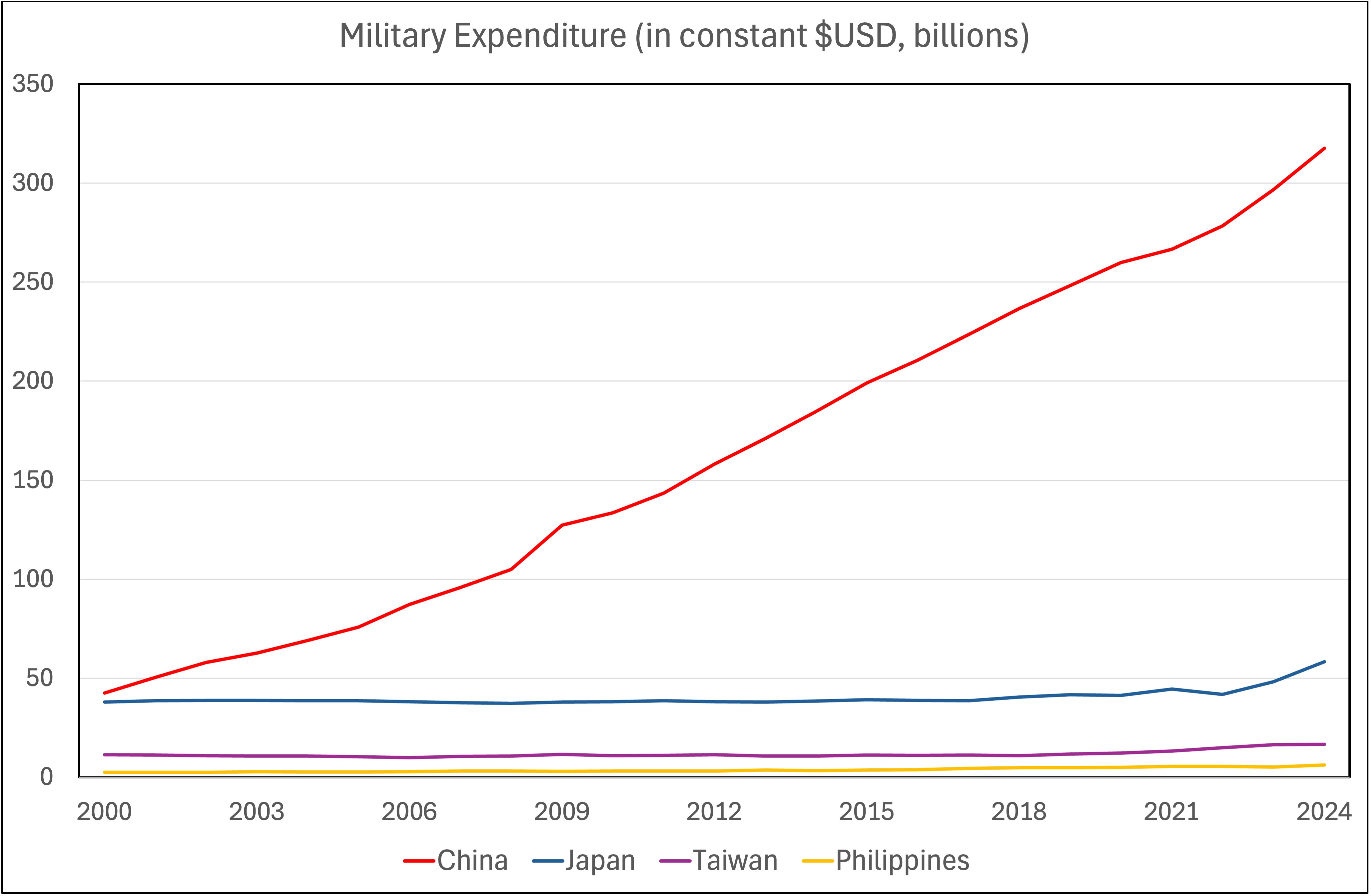
South Korea, which remains focused on the North Korean threat and is closely economically interdependent with China, appears unenthusiastic about joining a counter-China coalition. Trump administration efforts to clarify allied responses to war in Taiwan had a frosty reception. For the past decade or so, as US policies grew more hawkish toward China, the response by most East Asian countries has been, “don’t make us choose.”
By contrast, the Biden era shows that East Asian countries responded positively to a progressive foreign policy approach. They welcomed the administration’s “latticework” of “minilateral” engagement that eschewed counter-China balancing and emphasized initiatives related to technology, the environment, fisheries and coast guard activities, disaster relief, public health, and infrastructure.
For all of these reasons – the state of American politics today, rising worries about a climate crisis, the nature of superpower competition with China – the progressive vision is likely to be increasingly compelling.
UNDER CONSTRUCTION
Strong progressive voices in U.S. foreign policy debates would enhance the quality of US policy debates. Progressives are raising vital critiques—about national security policies and the insularity of the foreign policy elite—that the American public deserves to hear and that US leaders should confront. The result would be a smarter, more accountable foreign policy.
But before progressivism can move from the foreign policy fringe to the mainstream, its intellectuals and leaders have a lot of work to do. They need to strengthen their networks and institutions and to build out the intellectual architecture beneath their ideas. Progressives are proposing unprecedented changes in US policy but have not communicated a compelling logic of how goals would be attained. Why would Americans vote for redistributing their wealth to the Global South? Won’t reducing US power and leadership benefit authoritarians such as China and Russia? As Emma Ashford writes in her new book, progressives “have a clear picture of the world as they want it to be; they have almost no agreement on how to get there.”
Luckily the progressive bench has tremendous talent to further develop its vision. Blue Blaze will be exploring progressive foreign policy in guest posts coming soon — stay tuned for our next post by University of Michigan professor Megan Stewart.
“…and a pony!”
Rather than starting with policy recommendations or strategic priorities, shouldn’t one build those out from a picture of how the world works and how nations can best operate in that (real) world?
The unspoken assumptions underlying this grand strategy would seem to be that all problems in the world come from nasty greedy Americans and that if only we could be good altruistic Americans, we could make all our wishes come true in trice. To assess it properly, one would need more specificity on what precise changes in policy this strategy implies (for Taiwan, for Ukraine, for US allies, etc.) and what its likely consequences would be given other players’ actions.
We've had nearly 10 years of post-Obama progressive foreign-policy work, and one of the most common themes (other than climate change) has been anti-kleptocracy / globalized oligarchy. Indeed, someone (I forget whom) once described the most important division in the progressive FP space as being between those who prioritized anti-kleptocracy/oligarchy and those who prioritized anti-militarism.