
The Thinker III
why the Thinker is a hawk

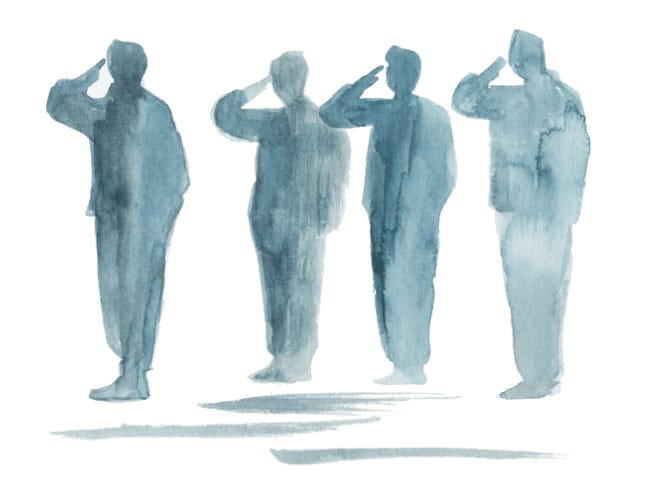
The Thinker is not a violent man. He spent most of high school avoiding any sort of physical conflict by cowering in bathrooms and skipping gym class. He has never had a bar fight, nor did he ever serve in the military. He doesn’t even work out. His only violent tendency is his secret admiration for the movies of Jean-Claude van Damme. And he loves the “Muscles from Brussels” films purely for their cinematic artistry.
Despite this pacific background, the Thinker thinks a lot about violence or more specifically war. And more than that, the Thinker is a hawk, which to say he often, even usually, advocates for war as an instrument of US policy. He frequently writes aggressive articles in major newspapers advocating forceful policies in eloquent tones. For him, it is always 1938 and his favorite disses all involve Neville Chamberlain. He has supported ever greater military spending, has advocated for multiple American invasions of weaker nations and decries any whiff of appeasement in the most derisive terms on social media.
Thinking is not Killing
The Thinker is, of course, adept in the ways of euphemisms. He supports “precision strikes against regime targets” rather than “raining death from the sky.” He doesn’t encourage “violent regime change” but he is ok with “humanitarian intervention.” He works to avoid “collateral damage” more often than he condemns “killing innocent people.” Regardless, at base, he is talking about violence and killing to a degree that clearly does not reflect his approach to gym class. On the surface, it seems odd that a life of thinking should lead to the persistent advocacy of violence. But for the Washington Thinker this apparent paradox presents little mystery. Most of the Thinker’s colleagues on the Washington foreign policy scene are also hawks. Doves are ridiculed, labeled isolationist, and relegated to the fringes of political life, doomed to political obscurity or, worse, forced to work at the Cato Institute.
Doves are ridiculed, labeled isolationist, and relegated to the fringes of political life
Arguably, the thinking profession’s hawkishness simply reflects American culture. A violent nation needs thinkers who can think violently, even if they are not themselves personally familiar with the ways of war. America has a long history of war and victory, of which it is quite proud. The nation was founded on war, expanded through war, and reached the heights of global leadership in the “good war,” World War II. It is a country that salutes its soldiers before every professional baseball game and allows them to board airplanes first (and then makes them sit in economy class).
A Skeptical Public
But recently, the nation seems to have entered one of its occasional pacifist phases, at least to judge by recent presidential elections. America seems tired of its “forever wars,” inspiring both Barack Obama and Donald Trump to make campaign promises to end stupid wars and avoid future ones. For both of them, running on the idea of peace seemed to resonate with the public. This burst of pacifism in an otherwise warlike nation reflects perhaps public frustration with the long string of expensive, losing battles that United States has fought in faraway lands for no particular reason.
But despite this recent record of unblemished failure, the Thinker has not really budged from his hawkishness. The Thinker’s response to this change in the cultural mood mirrors the bishop’s wife upon hearing about Darwin’s Theory of Evolution. “Let us hope it is not true,” she opined, “but if it is true, let us hope that it does not become widely known.”
Despite this recent record of unblemished failure, the Thinker has not really budged from his hawkishness
The Thinker first insisted that the politicians, despite their tendency to win elections more than thinkers, have misread the public mood. Polls were commissioned that showed that the public really was ok with spending vast sums and even some soldiers’ lives on faraway wars that had little impact on their daily lives. The polls alas did not stand up to the electoral realities. So now, the Thinker spends his time demanding “leadership” from the political class that can explain to the benighted masses why continued violence abroad remains necessary to American security and prosperity at home.
In the end, the problem the Thinker has with peace is more than just cultural. It is professional. Foreign policy thinkers need war like seismologists need earthquakes. Without war, it is not clear that America would need foreign policy thinkers. Even more to the point, war is a professional bonanza for the Thinker. The more war breaks out the more society seeks his advice, the more the Thinker appears in important media outlets, and the more funding flows to his organization.
Foreign policy thinkers need war like seismologists need earthquakes.
The avowed purpose of a foreign policy think tank is to prevent war, but all the professional incentives point in the other direction. Indeed, a war in the Thinker’s region of expertise is a career-making opportunity, finally validating his questionable decision to study the Yemeni dialect of Arabic in graduate school. By contrast, avoiding that war would make the Thinker just another quirky expert on some weird region with inadequate sanitary facilities. Thinking is a perverse business in the end.
So, needs must, the Thinker remains a hawk. In this precise political moment, he feels a little counter cultural. But he has faith that the world, with just a little encouragement, will provide the wars he needs. And when it does, he will deplore the tragedy of it all. Because the Thinker is not a violent man.